The Scholar’s Rocks Series: Threaded Whispers of Time
About the Artwork
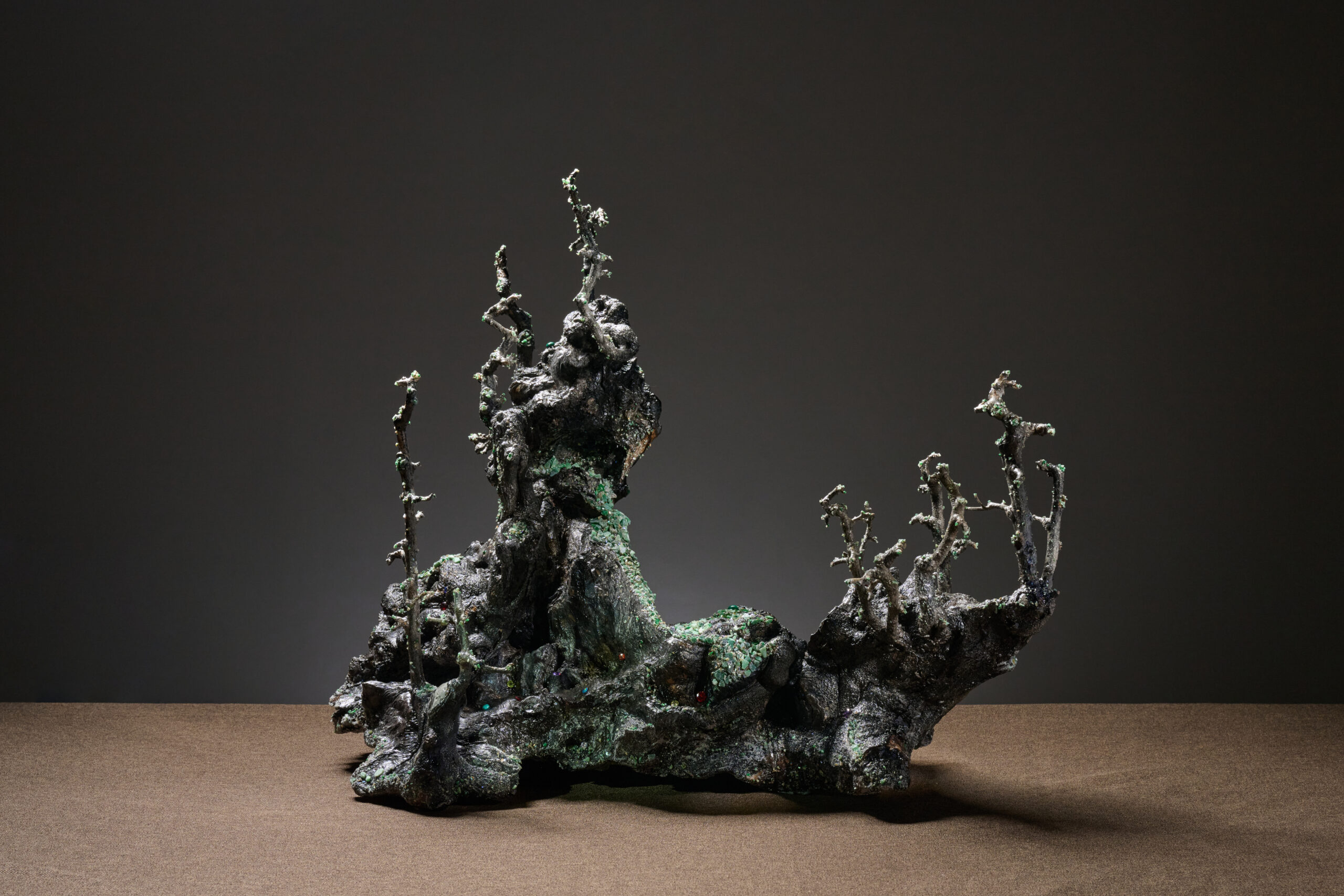
The Scholar’s Rocks Series: Threaded Whispers of Time represents a profound collaboration between Master Wang Xinyuan and Elaine Yan Ling Ng, who together reinterpret the story of scholar’s rocks through the medium of textiles. Mirroring how strata are shaped layer by layer, Elaine sculpts layered fabric into three-dimensional forms, transforming the seemingly fragile fibres into a symbol of enduring strength.
Elaine’s innovative “Reverie” textile becomes the new canvas for Master Wang’s exquisite Guangzhou Embroidery. This synergy allows the delicate stitches of Master Wang and his apprentices to stand alone as a sculptural creation, manifesting abstract patterns and vibrant colours.
Each work in the collection explores a different stage in the life of a scholar’s rock, blending contemporary copper-knit technology with the handicraft traditions of Guangzhou Embroidery and crochet. The resulting large-scale installation—majestic and free-flowing—exemplifies the limitless possibilities for contemporary Guangzhou Embroidery. Together, these pieces offer a powerful textile-based meditation on the transformation of matter, technique and time.
Story of Traditional Craft
According to Master Wang, Guangzhou Embroidery is a collective term for the craft of folk embroidery in Guangzhou, specifically found in the city’s enclosed areas, such as Nanhai, Panyu, and Shunde. The craft of Guangzhou Embroidery is an irreplaceable and inseparable part of Lingnan culture as it embodies the customs, lifestyle and aesthetics of the region. To recognise its cultural significance, it was listed on the National Intangible Cultural Heritage list in 2006.
Guangzhou Embroidery dates back to at least the Tang Dynasty. The craft became widely exported in the Ming era to Portugal, England and France, and was prized by European courts. In the 17th century, the British Embroidery Guild was established on account of Queen Elizabeth I’s admiration for Guangdong’s silver and gold embroidery, which led to the founding of royal embroidery workshops modelled on Guangdong counterparts. Large export demand from the late Ming to mid-Qing shifted production from household workshops to commercial studios and markets.
Guangzhou Embroidery features figurative motifs such as dragons, phoenixes, peonies and various fruits from the Southern region. These auspicious elements, stitched with vibrant colours, are juxtaposed on the canvas to narrate the animated stories of Lingnan culture. Guangzhou Embroidery is celebrated for dense, vibrant compositions, intricate patterns and rich colours, often leaving little blank space—gaps are filled with landscapes, shrubbery or tree trunks to create a compact, lively effect. Faced with the lack of innovative design, community engagement and international exposure in passing down Guangzhou Embroidery, Master Wang strives to bridge the rift between tradition and the contemporary art paradigm. Mesmerised by the colours and texture of the bronzeware he saw in museums, Master Wang aspires to capture its luster through his craft over countless iterations and modifications. Nowadays, his creations feature a variety of subjects that resonate with the younger generation, such as anime characters.
Making Process
The foundation of this installation is the “Reverie” textile series, a machine-knit copper textile knit directly to shape, developed by Elaine. Knitting copper to shape introduces a surprising quality—fluidity. The knit construction makes the material hard yet light, enabling the creation of volume without the need for heavy scaffolding.
Elaine describes her craft techniques as “digital hand-made—from code to sculpt,” a hybrid of techniques that blend old and new ways of making. The scholar’s rock’s form exploration begins with scaled paper prototypes. Creating mockups with paper and later stainless steel mesh allows Elaine to decide how the material guides the shape and the work’s spatial presence. Projecting a light onto the full scale prototype, she traces the shaded zones. These zones inform specific areas for Guangzhou Embroidery, marking the “Erosion Holes” reminiscent of scholar’s rocks. She develops the shadow outlines into digital print patterns, which she UV prints and layers into the fabric. In preparation for Guangzhou Embroidery, Elaine creates reinforced “Reverie” panels along the edges to ensure stability and uniform tension, ensuring precision.
Master Wang draws from over twenty years of expertise to enhance the vividness of the work such as experimenting different colour combinations to provide dimensionality for the patterns. Firstly, a single-coloured silk yarn is split by hand into 200 strands that are thinner than hair. Then, Master Wang and the apprentices supporting his workshop spin the fragile strands of differently coloured thread into new yarn and stitches it onto the metallic structure, elevating the surface texture by referencing Guangzhou Embroidery techniques and using silk thread with a metallic sheen. The embroidery not only embellishes, but also strengthens the structure, adding depth, tactility, and a balance of hardness and softness. In this artistic installation, material and technique are mutually dependent—each empowers the other to achieve sculptural intricacy and strength.
Using the needle as his brush, the thread as his ink, Master Wang merges tradition with innovation as his silk threads meet Elaine’s metallic textile. They adopt a loop stitch to enhance the texture of each stitch against the “Reverie” textile; They break thousands of needles in the arduous process.
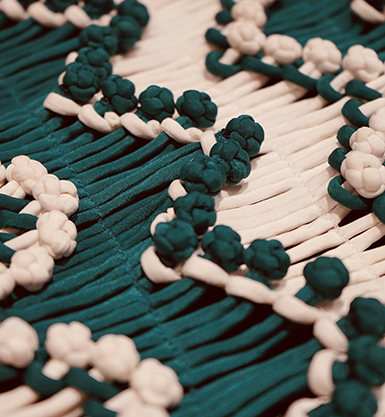
Elaine then collects the completed panels, detaching the metallic pieces from the embroidered fabric to sculpt and reattaching them to the final body. She adds rings of hand-crocheted, moss-like copper wires to soften and enrich the peripheries, completing a theatrical reimagination of a scholar’s rock.
Artworks from same series

OTHER WORKS FROM EXHIBITION


Auspicious Horizons
Yue Kee Rattan Factory & Ahung Masikadd & Barnard Chan & Cecilia Lai