The Shades of Clouds
About the Artwork
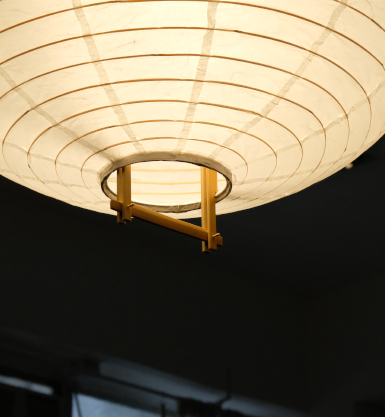
This light installation, The Shades of Clouds, draws its inspiration from the inner monologue of Xi Shi (西施), one of the Four Great Beauties of ancient China, as depicted in the renowned Cantonese opera, “Five Lakes Boat Trip” (《五湖泛舟》). The artwork reimagines the lyrics through cloud-shaped Morse code. The work transforms Xi Shi's love, sacrifice and inner conflict into a poetic flow of light and shadow.
Through Morse code, the work mirrors the melancholy and solitude illustrated in the lyrics, as the cloud forms symbolise the ephemeral nature of memory and emotion. The interplay of light and shadow evokes Xi Shi’s unwavering determination and hopefulness, and echoes Hong Kong's resilience and persistence in seeking transformation.
Story of Traditional Craft
Ink Painting
The instantaneity of ink painting mirrors life itself: once the ink reaches the paper, it stains without an opportunity for amendment. Each stroke carries the memory of past practice, imbued with the fleeting thoughts and emotions of the moment, akin to life’s irrevocable choices. Past brushstrokes serve as a guide, discerning the rhythm of lines and the lingering echoes of ink diffusion to determine the next stroke—whether to extend the undulations of mountains, preserve profound negative space, or let the ink drift like clouds, all shaped by a keen perception of the existing trajectory. Ink artist Sim Shum Kwan Yi believes that, ink painting, particularly literati landscapes, harbours rich personal emotions and socio-political codes. The lines and imagery of mountains and streams subtly reflect the artist’s inner world, refracting the era’s transformations and social context, endowing the artwork with profound expressions.
Revolving Lantern
The revolving lantern, a traditional festive craft, is unique in its use of thermal convection to continuously rotate silhouettes inside the lantern, forming dynamic visual sequences. This technique dates back to the Tang and Song dynasties or earlier, which was recorded as "shadow-play lanterns" in “Wu Lin Jiu Shi II” (《武林舊事·卷二》) from the Southern Song dynasty, and is celebrated for its intricate mechanics and vivid interplay of light and shadow.
Traditional construction integrates multiple physical principles: a frame of bamboo or wire holds a turbine mechanism driven by heat from a candle. As hot air rises, it spins the turbine, rotating attached paper figures or landscapes to project moving scenes onto the lantern surface.
Media artist Chris Cheung builds upon this physical structure, continuing and reinterpreting it with contemporary technology. In The Shades of Clouds, he replaces candle heat with precisely controlled motors and traditional cutouts with laser-cut “cloud codes”, extending the revolving lantern’s legacy as a vessel of “light-and-shadow storytelling.”
Making Process
Involving 5 key stages, the artwork is an interplay between light and shadow, accompanied by the sonic element of the Cantonese Opera and the visual element of ink art, constructing a multi-sensorial experience that transcends space and time.
1 - Design and Coding
Sim generated Morse Codes based on the pinyin of the selected tune - Cantonese opera “Five Lakes Boat Trip” 《五湖泛舟》, transforming the dots and dashes into ink-wash cloud patterns through brushwork. These hand-painted images were then scanned into digital files, with software ensuring harmony between aesthetic expression and coding logic.
2 - Laser Cutting
The designed “cloud code” patterns were precisely etched onto rice paper using a high-accuracy laser cutter. This stage demanded extreme precision to guarantee crisp, clear projections in the final presentation.
3 - Mechanical Assembly
Chris and his team engineered the mechanical structure of the light installation. At the core of the paper lantern, a low-noise, variable-speed micro motor replaced the traditional candle and heat convection system. The motor was connected to a cylindrical scroll of washi paper, driving the carved “cloud code” cylinder in smooth, continuous rotation.
4 - Light and Motion
Inside the rotating paper cylinder, a warm halogen bulb casts light outward. The angle, colour saturation, and intensity of the light were meticulously calibrated to achieve optimal projection clarity and atmosphere.
5 - Calibration and Presentation
The fully assembled electric revolving lantern was installed in the exhibition space for final projection tests. Through careful adjustment of rotation speed and lighting, flowing cloud shadows were casted onto the wall, visually echoing the ideorealm of the artwork.
Artworks from same series

OTHER WORKS FROM EXHIBITION
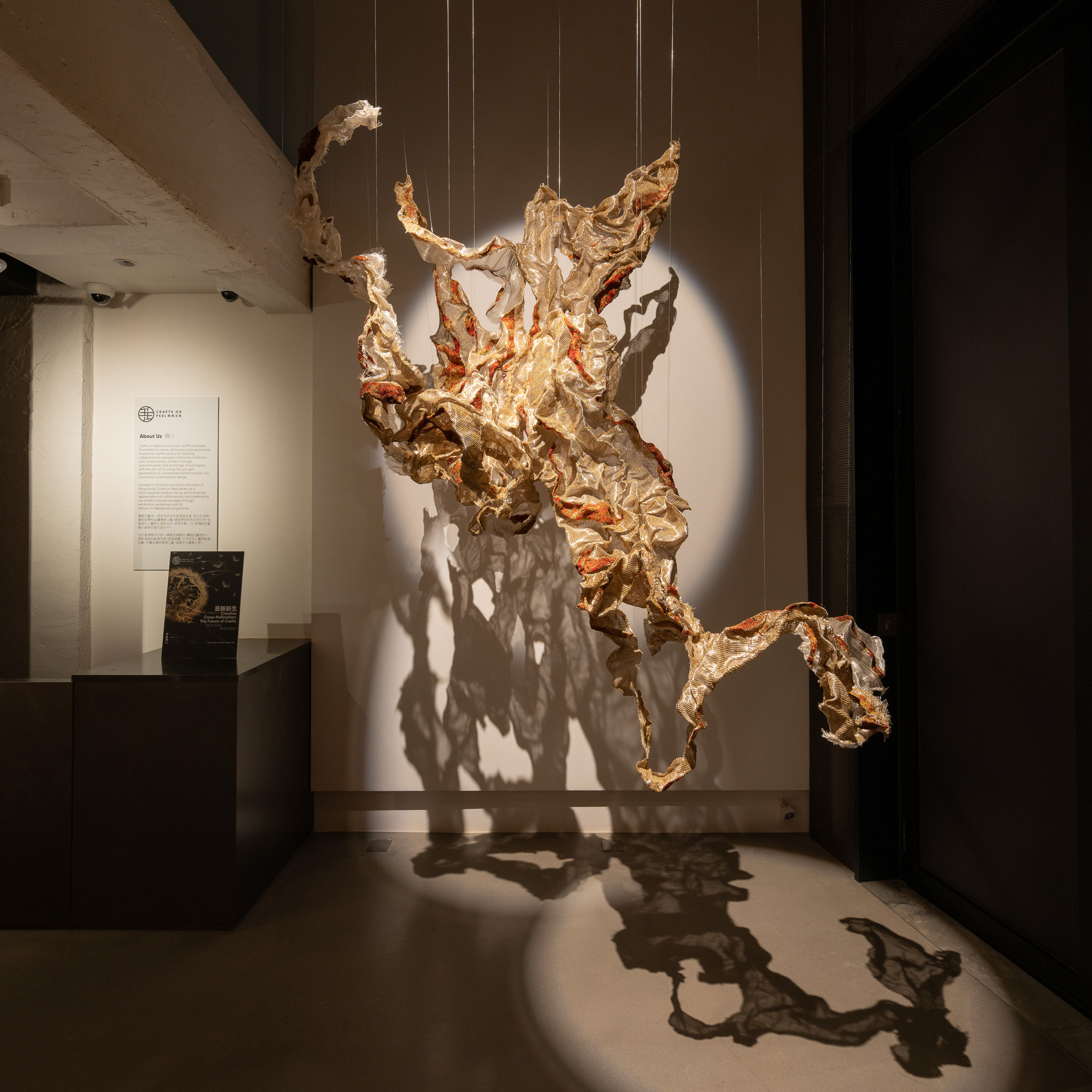

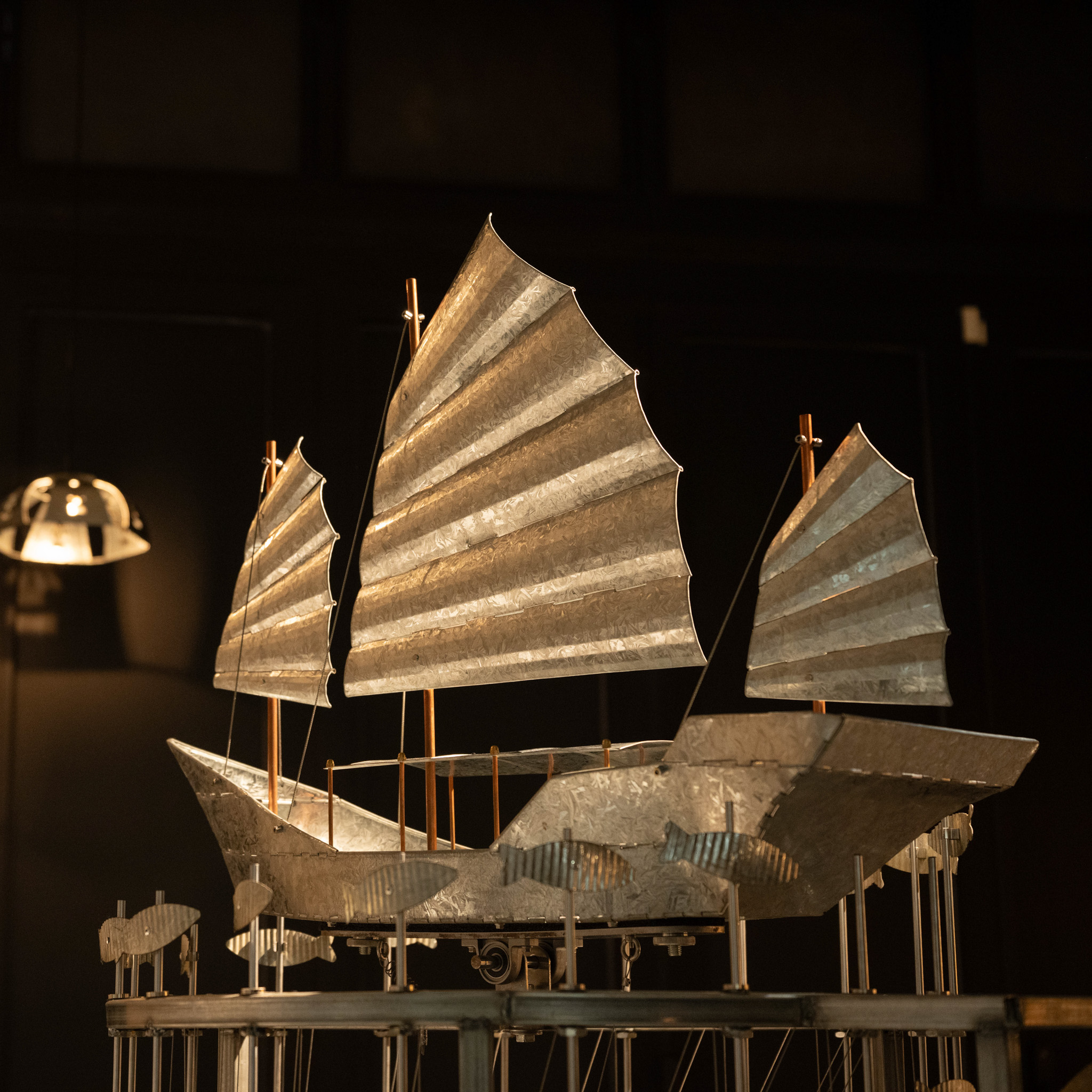


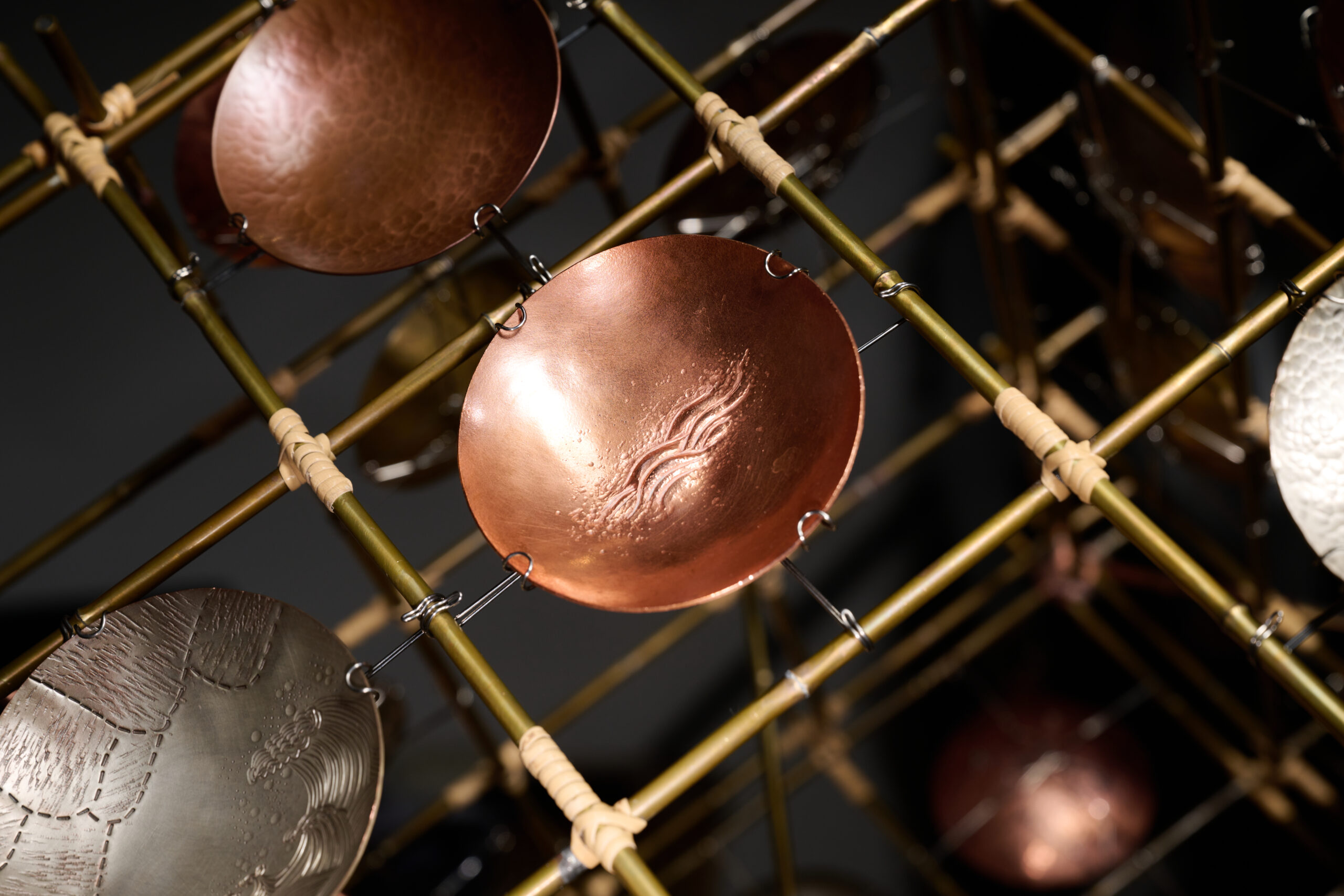

Auspicious Horizons
Yue Kee Rattan Factory & Ahung Masikadd & Barnard Chan & Cecilia Lai